
Workshop log · Software Projects
I Built a Logic Puzzle for Thorncroft Mysteries
The first Thorncroft Mysteries novel, Terror in Stone, is written. I’m now working through the self-publishing process, which turns out to contain rather more administration and rather fewer dramatic rooftop pursuits than the book.
Naturally, while doing that, I built a game.
You can play the Thorncroft Mysteries logic puzzle in your browser. It’s free, it doesn’t require an account, and it won’t ask you to buy a small sack of imaginary rubies before revealing the last clue.
From story world to evidence board
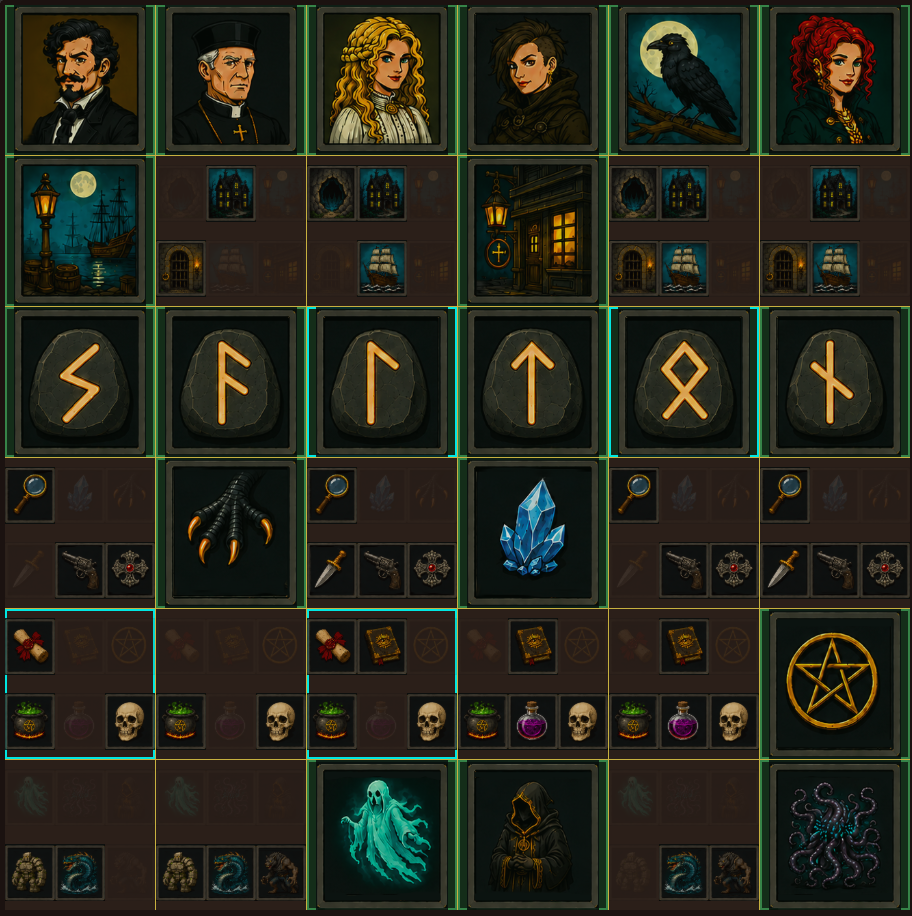
The game is a classic logic-grid puzzle dressed as an investigation in Blackharbor. Six investigators occupy six positions. Each one is connected to a location, rune, tool, piece of evidence, and monster.
The job is to work out exactly what belongs where. The evidence board above shows the six rows: investigators, locations, runes, tools, evidence, and monsters.
Every case has one solution. The clue cards give you enough information to reach it without guessing—although they make no promises about preserving your dignity while you get there.
Left-clicking locks in an answer. Right-clicking eliminates an impossible candidate. As the board narrows, solved cells turn green and the mass of possibilities begins to look like an actual investigation instead of Amelia Thorncroft’s filing system after a difficult week.
The clues do the heavy lifting
The clues describe relationships between the tiles. Two things may share a column, sit beside one another, appear in a particular order, or be separated by a specific distance. Other clues tell you what definitely isn’t true, which is often just as useful.
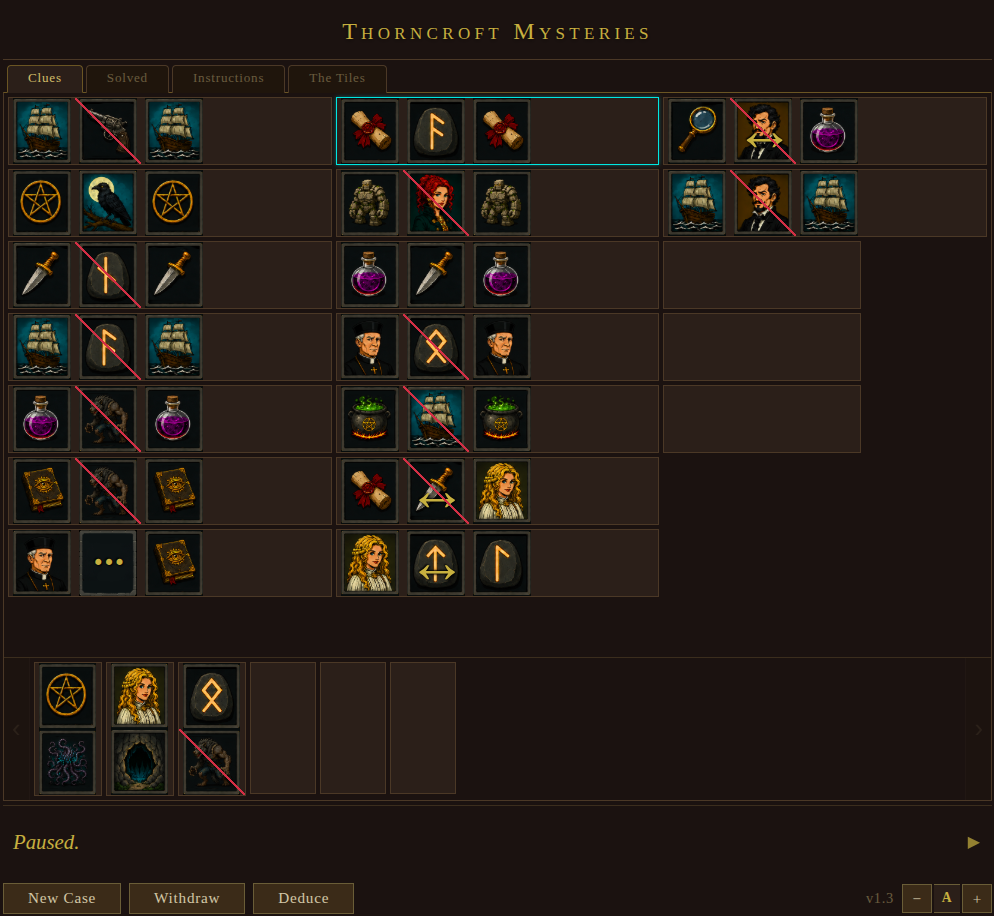
Used clues can be moved out of the way. Withdraw undoes the last action. Start From Scratch resets the current case, while New Case generates another investigation. If you’re thoroughly wedged, Deduce points out one valid elimination and the clue that supports it. It’s a nudge, not an automatic solve button.
Why build a game for a book?
Because a fictional world shouldn’t have to sit perfectly still between two covers.
The puzzle let me turn characters and bits of Blackharbor lore into something the reader can handle. Amelia, Evie, Corax, Clara, Vexley, and Althain aren’t just names pasted onto generic game pieces. Their tools, fears, habits, locations, and unpleasant encounters are drawn from the same world as the novels.
There’s also a practical reason: I like building things. Sometimes that means foam, plaster, leather, or a laser. This time it meant JavaScript, a pile of icons, and the increasingly suspicious feeling that I had created a logic problem in order to test my logic-problem generator.
A note about screens and mice
The evidence board is designed for a desktop or laptop with a mouse. It uses left- and right-click actions and needs enough room to show the whole case. A phone screen simply isn’t the right workbench for it, so the game politely sends mobile visitors away before anyone loses an afternoon arguing with a six-pixel rune.
The wider world, book information, case files, and Blackharbor lore live at thorncroftmysteries.com .
When Terror in Stone is published, I’ll add it here properly. For now, open a new case and see whether Dr. Thorncroft should have trusted you with the evidence.